Showing posts with label artist. Show all posts

Monday, November 24, 2014

Whisper in my mask


Whisper in my mask
TarraWarra Biennial, TarraWarra Museum of Art
16 August – 16 November 2014

TarraWarra Museum of Art has been mounting biennial’s for eight years. The exhibitions are designed to chart new developments in contemporary art. From the outset the museum has engaged external curators to conceive exhibitions that explore an idea, theme or tendency in contemporary art practice. Whisper in My Mask, the fifth in this line is a collaboration between curators Natalie King and Djon Mundine. King, who amongst other shows, curated Up Close: Carol Jerems with Nan Goldin, Larry Clark and William Yang at Heide in 2010 is interested in edgy subcultures and relationships - between artists, milieus, individuals; Mundine’s writing and curatorial practice has focused on Aboriginal art, including the remarkable Aboriginal Memorial (1987-1988), 200 hollow log coffin poles from Ramingining, a project similarly geared towards the collective. 

While King and Mundine have gravitated towards different curatorial subjects, in their joint catalogue essay King and Mundine offer an insight into their shared methodology: “ The relationality  of curating individual artists, community, society, inside and outside the gallery, and creating a conversation between objects and community through a number of devices and on a number of levels, is something we unconsciously just thought was our normal practice.” King and Mundine’s practice foregrounds relationships, collaboration and conversation and this is evident in the assembled artists and works. This methodology underpins the biennial in a myriad of ways, and, in fact, forms the most cogent framework for thinking about the exhibition itself.

The exhibition features 16 individuals and groups, including a number of collectives; boat people, a Sydney based collective of 10 who contributed a video-based work, The Tjanpi Desert Weavers, a dynamic social enterprise that were commissioned by the biennial to make sculptures, as well as artistic collaborations: Destiny Deakin and Virginia Fraser, Veronica Kent and Sean Peoples, and Karla Dikens’ who took photographs in partnership with Lismore Soup Kitchen and Southern Cross University, and sisters Gabriella Mangano and Silvana Mangano. 


Whisper in My Mask explicitly draws on the trope of the mask. The accompanying exhibition catalogue essays elaborate an understanding of the origins, meaning, symbolism and use of masks in Western and indigenous cultures. Masks allude, we know, to human disguise, to camoflage, to erasure, secrets and hidden meanings. How then is this theme articulated across the exhibition? The curators have taken a broad perspective selecting artworks that either formally or by way of subject probe this idea. Walking through the gallery space there was a palpable sense of intensity. Between Polinexi Papepetrou’s photographs of clowns, some wearing costumes made of the Union Jack, boat-people’s video instillation Muffled Protest depicting the collective artists sitting on the steps of the Sydney Opera House with their faces covered by the Australian flag, Tony Garifalakis’ photographic camouflage portraits, and Nasim Nasr’s video installation of a weeping woman wearing a chandor,  I felt the full impact of so many potent symbols in close proximity. Fiona Foley’s sculptural installation of towering serif letters spelling out Black Velvet rendered in wood and metal (referring to the racial slur and not simply fabric) ratcheted it up a notch. Foley’s words loomed like a provocative headline in an exhibition that read like a newspaper; a cacophony of people, stories, recent events demanding action.

An edited version of this review appears in the forthcoming issue of Artlink 34 #4 Sustainable? out in December.

image: Tony Garifilakis, The Hills Have Eyes, 2012

Friday, December 20, 2013

IN MEMORY Martin Sharp 1942-2013


Martin SHARP
Australia 1942-2013
Mr Tambourine Man 
1967 London
colour screenprint on foil mounted on cardboard
Gift of Dick Richards 1999
Art Gallery of South Australia
997G30

Martin Sharp was a unique figure in Australian art. A pop artist, provocateur and connoisseur of popular and folk culture, he carved out a significant Australian and international career outside the gallery system. He was born in Sydney in 1942 and studied at the National Art School (Sydney). In 1963, with students Richard Neville and Richard Walsh, he established OZ magazine, which quickly challenged the conservative establishment and led to court cases over charges of obscenity. Sharp moved to London in 1966, where he continued to work on OZ magazine as art director and a designer, and on art exhibitions. While in London he created some of his most memorable images, designing record covers and posters for Eric Clapton (with whom he shared a studio) and other musicians. His distinctive aesthetic of collaged elements from art history, nineteenth-century engravings and popular imagery conveyed the hallucinogenic effects of marijuana.

Sharp returned to Australia in 1970 and opened the Yellow House in Sydney’s King’s Cross, which was inspired by Vincent Van Gogh’s dream of a communal house for artists. Sharp worked with artists to decorate the house, which was open to the public twenty-four hours a day, seven days a week, and hosted concerts and happenings. Sharp was invited to repaint Luna Park’s famous façade in Sydney in 1973, becoming a vocal activist for its preservation. In his later years he worked as a theatre and set designer for Nimrod Theatre, Sydney, and continued to work on a film about musician Tiny Tim, which had preoccupied him for many years.

Throughout his career Sharp celebrated the potency of juxtaposing popular culture with ‘high’ art. He was an avid collector of comics, American and Australian cartoon characters, and fairground objects, which he bought together in unexpected combinations in his art and in his home, which he called his ‘Dreamuseum’. His idiosyncratic art was prescient of many developments now at the centre of contemporary practice: the elevation of ‘low’ art forms, folk and popular culture.

– Maria Zagala


See Marin Sharp's works at AGSA, Adelaide, January 2014.

Friday, August 9, 2013

Polka dot: confetti


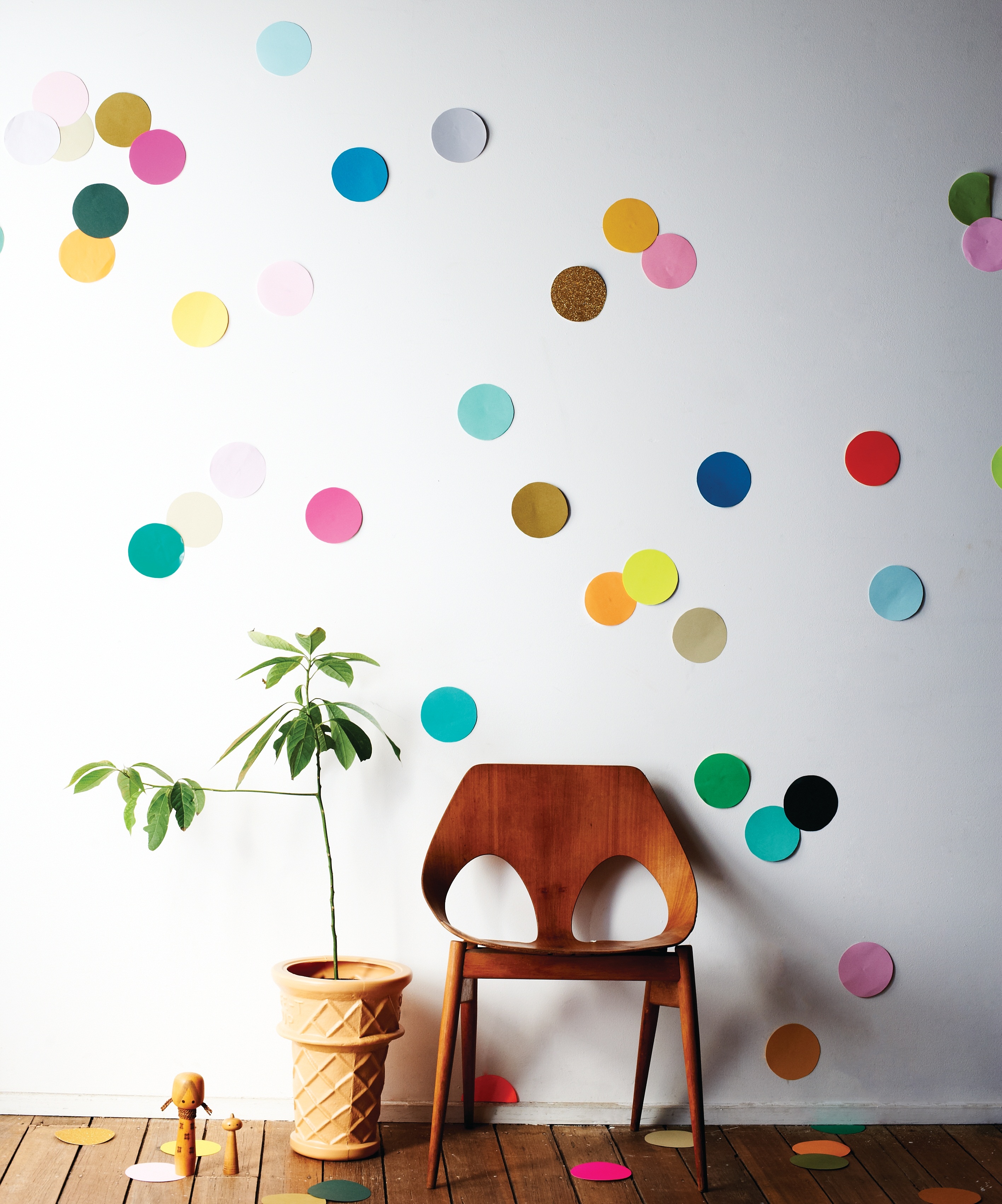
I haven't seen the ice cream lamp turned into a pot plant holder, but that's the genius of Beci Orpin. That lady has ideas. It's very nice seeing bits of coloured paper stuck to the wall, wouldn't you agree? I know spring is not quite here but today's sunshine was literally a ray of hope. Just thinking about melatonin puts me in the mood for ice cream.

Friday, May 25, 2012

Vale Michael Callaghan

Michael CALLAGHANREDBACK GRAPHIXMichael CALLAGHANAlison ALDERNick SOUTHALLREDBACK GRAPHIXWOLLONGONG OUT OF WORKERS UNION, Raise the dole dance.

Today Michael Callaghan (4 November 1952 – 19 May 2012) is laid to rest in Exeter, New South Wales. The flier with funeral arrangements read:

Artist – Raconteur – Reader – Collector – Pleasure Seeker – Holder of Hearts.

I'm not sure I've ever read a more affectionate description of a person in such few words.

When I finished writing my book on Redback Graphix Michael asked me which poster I would like for myself. One of the posters I selected was this 1984 poster for Raise The Dole Dance. It hangs in my kitchen, its live-wire figure carving it up on a Japanese dance floor. I never tire of its vibrant colours, the sheer mentalness of it. I'm a long way from down-and-out Wollongong and those desperate economic times. Michael captured the restless spirit of its underclass without peer. Like all great designers he had a freaky sensitivity to atmosphere. In words and pictures, he gave it form.

We'll miss you.